- EN
- ES

Circular economies for olive oil wastes – a pressing issue
By Luca Urciuoli, Adjunct Professor
Across many agricultural sectors there is growing interest in creating more ‘circular’ economies – exploiting what would otherwise be considered as waste products to create further products or sources of energy of economic value. However, almost inevitably the economics of these secondary operations are fairly marginal – after all, if there was easy money to be made, everyone would be doing it! – and so it is imperative to optimise operations and the resources devoted to them.
Previous researchers have investigated the financial viability of circular bio-economies using techniques such as Mixed Integer Linear Programming or simulation. But these approaches have largely ignored major elements. Firstly the logistics of collecting, storing and transporting wastes (or feedstocks as they should be considered) economically. Second is the related question of determining the optimal lot sizes and schedules for delivery to a transformation plant while ensuring uninterrupted production, and minimising downtime when the plant may be switching between different feedstocks and processing routes.
The logistics challenge for agricultural wastes is often non-trivial. Wastes may be generated on a seasonal basis, and the weather can significantly affect the timing of those seasons and also the quantity of waste generated. Additionally, wastes that are generated during growing or harvesting (as opposed to processing) are often widely dispersed across terrain that may not be simple to access, in rural areas with limited and poorly maintained roads, not well suited to large or heavy vehicles, and which may be at some distance from the destination processing plant.
With colleagues Michael Alexandros Kougioumtzis and Emmanouil Karampinis of the Centre for Research and Technology – Hellas in Athens, we have taken a new approach, using Geographic Information System data to inform a hybrid heuristic-simulation model, and we have validated this by applying it to olive cultivation in the Fthiotida region of Greece.
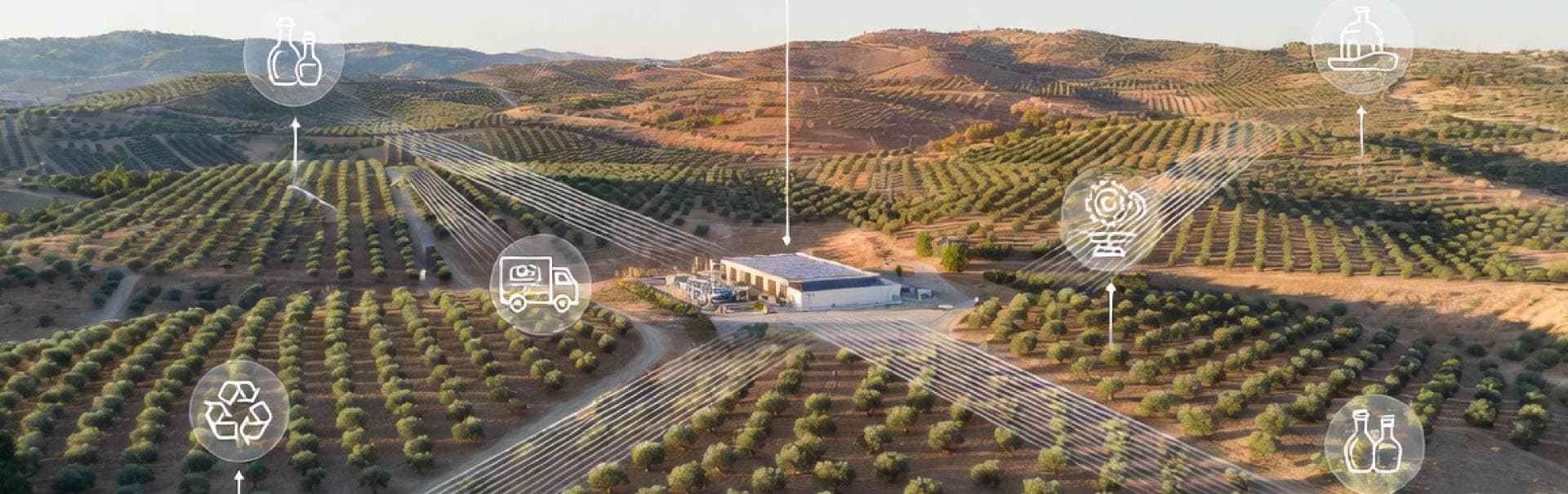
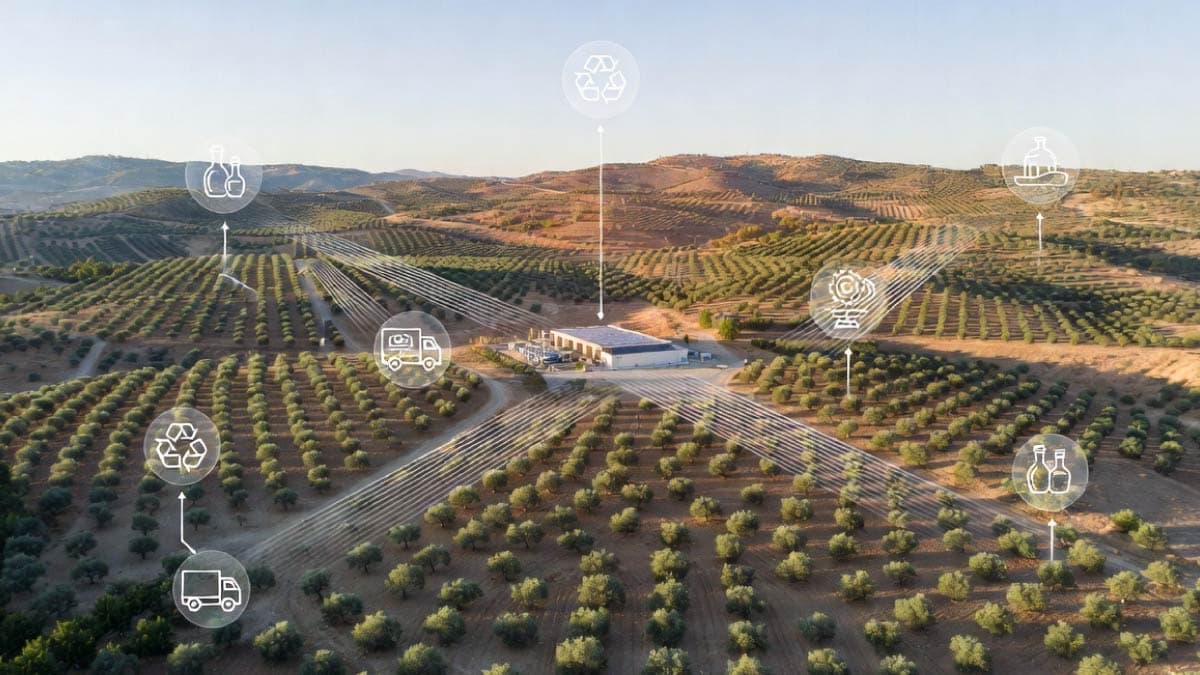
Serving the olive industry in this area is a plant which processes two distinct waste streams - Two Phase Olive Mill Waste (TPOMW), and olive grove prunings. TPOMW is a slurry deriving from the pressing process and still containing recoverable amounts of oil which can be refined into olive pomace (which has several industrial uses) and dried to make olive cakes for bio-fuel. The prunings result from the need to manage and control the growth of olive trees, and are converted into pellets for fuel (including fuel for process heat in the plant itself). These prunings have to be cleared from the groves as otherwise they can damage soil condition, obstruct access for other operations such as spraying, and, an increasing concern, potentially fuel wildfires which are becoming all too common.
Happily, these wastes are created in different time periods – the pruning season runs from March to October, while TPOMW arises after harvest, in November to February, when the olives are pressed (although as noted the vagaries of the weather can make these dates rather variable). Less conveniently, although the two processes are largely independent, they share a common facility, the dryer (completely separating the two production lines would require significant additional investment) and this shared production element presents an additional logistics hurdle. An objective therefore is to maintain feedstock availability to ensure that the dryer is operating at full capacity as much as possible while minimising the downtime required for cleaning and so on during the switchover from one production process to the other.
TPOMW arises at just a few locations (the pressing mills) and so the logistics are relatively easy to plan. That is not the case with the prunings. These are obtained by using harvesters which go out to the groves, collect and shred the prunings and load them onto one of two trucks which shuttle between the harvester and the plant. Clearly, if too few harvesters are deployed the supply of feedstock, and thus the operation of the plant, risks interruption, idle time and lowered output.
On the other hand, too many harvesters can create build-ups of stock. The harvesters are then idled for a period, and additional costs are incurred because extra infrastructure is required to accommodate inbound prunings and work in progress. At the same time, accumulations of inventory may deteriorate in high humidity, and present a fire risk. So there are a lot of variables including truck capacity, cycle time (how long it takes a truck to shuttle between harvester and plant – that can also place a constraint on how distant the groves that are serviced can be), and the, essentially random, effects of weather on seasonality and quantities.
The problem therefore presents as a merger of the Capacitated Lot Sizing Problem, and the Vehicle Routing Problem (both with modifications), and the resulting function has a number of distinct terms. These include the profit from selling the products; and operational cost: bio-commodity (ie saleable product) inventory costs, production costs, idle time (both arising from inventory stock-outs halting processing, or alternatively by a build-up of excessive inventory postponing switch-over to the other process stream), biomass supply inventory levels, biomass procurement (the plant is purchasing these inputs from individual growers), and transportation.
We ran our model against our real life case, for one, two, three and four harvester/truck combinations. In each case we were able to calculate values for harvesting time, Carbon Dioxide emissions, costs, revenues and annual profits.
The system performs very well for a large number of data inputs, including our database of more than 6,000 fields. Also, to address the large number of variables we shift from classical linear optimization to heuristics, which obviously may have some slight biases, but they perform exceptionally in real cases where companies need to update and optimize operations in the short to medium term.
As expected, harvesting time decreases as more harvesters are added. Less obviously, CO2 emissions are minimised in the two harvester case, which also optimises costs and profits. (In fairness, the margin between the two and the three harvester cases is quite slim on most of the metrics). Idle time is also minimised in the two harvester model. In terms of profitability, taking the long term (12 year) view and applying Net Present Value to the investments, the two harvester model is most profitable (followed by three, four, and one) although interestingly the three harvester case reaches break-even first, in 24 months compared to 36 months for the two harvester option.
We feel that our approach has been validated as far as it goes, but there remain factors that are unaddressed. For example, farmers are keen to have prunings cleared as promptly as possible (because of the soil condition, access and fire risk issues already noted) which may imply shorter pruning seasons and the demand to use more harvesters than is strictly optimal.
We also haven’t factored in possibilities such as severe weather or harvester malfunction (in both cases availability of additional harvesters might improve resilience and, ultimately, profitability). We also haven’t looked at the implications of different models for the workforce, for example whether employing part-time workers is viable in terms of costs or simply in attracting labour. In addition, our analysis was limited to only two seasonal products; increasing the complexity of the models by evaluating a broader range of locally available feedstocks would offer a more comprehensive understanding of system performance and resilience.
For more information visit
https://www.sciencedirect.com/science/article/pii/S0959652624035492

