- EN
- ES

Redefining Urban Mobility: The Role of Perceived Accessibility in Sustainable Transitions
By Diana Alarcón and Dr. Aldo Arranz
Policymakers and planners often prioritize tangible metrics such as kilometers of new tram lines, the density of bike networks, or the electrification of vehicle fleets. These form the “hardware” of the city, that is, the physical structure that enables mobility and supports the transition toward more sustainable systems.
However, a city is not merely a collection of engineered systems. It is also shaped by how people perceive, interpret, and engage with the mobility opportunities around them. Beyond its physical infrastructure, every city is a socio-technical ecosystem defined by the habits, norms, and perceptions of its inhabitants. This is the "software" of the city: what researchers term Mobility Culture.
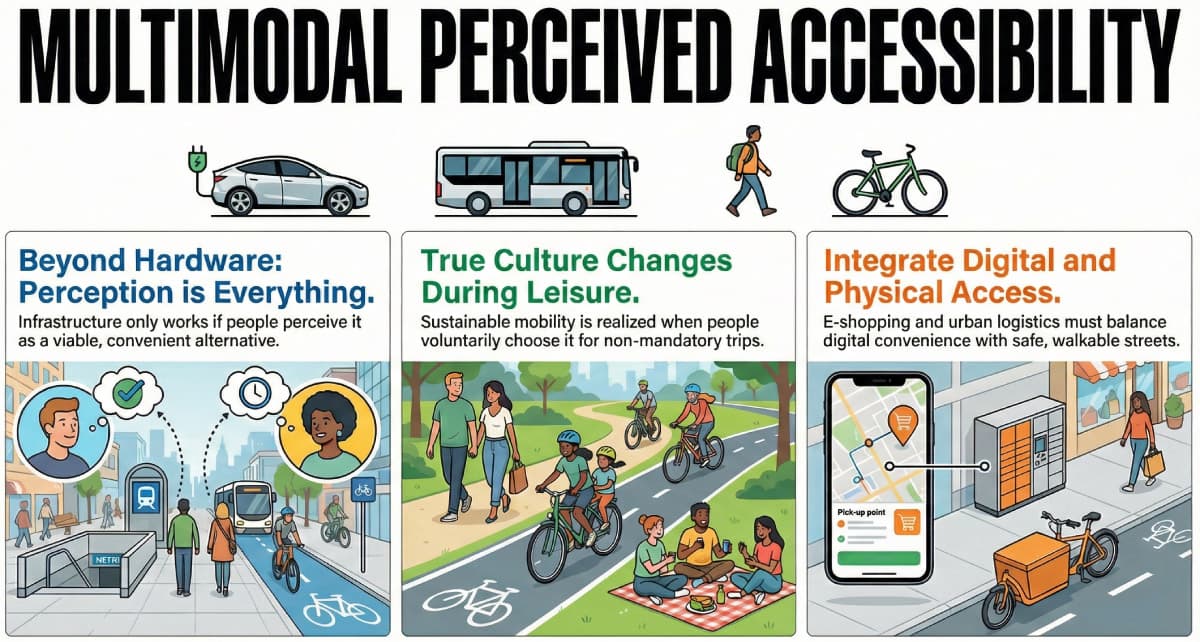
The PhD thesis by Diana I. Alarcón-Bohada, conducted within the TRANSFORM research project, an MSCA-DN funded by the European Commission, addresses the critical dissonance between these structural and perceptual dimensions. A recurring challenge in urban mobility transitions is that improvements in infrastructure do not always translate into corresponding changes in how people experience or evaluate their mobility options. Even when sustainable modes are physically available, they may not be perceived as viable, convenient, or desirable alternatives.
To diagnose this gap, Diana’s research focuses on a concept called Multimodal Perceived Accessibility.
While traditional transport approaches assess "spatial accessibility" (e.g., the proximity of a bus stop), multimodal perceived accessibility evaluates the "cognitive map" of the user. It captures how people interpret the feasibility, quality, and suitability of their mobility options within their everyday lives. This distinction is crucial, as mobility options that are physically available but not perceived as viable or adequate may not effectively contribute to a true mobility transition.
Beyond Captivity: Understanding Mobility Through Choice
A key challenge of this research is that not all travel behavior reflects cultural values equally. To better understand mobility culture, it is necessary to distinguish between mandatory and discretionary activities. Mandatory activities (such as commuting) are often characterized by "travel captivity," where individuals may rely on specific transport modes due to structural constraints rather than personal preference. This is a behavioral adjustment, not necessarily a cultural shift. In contrast, discretionary activities (shopping, leisure, social visits) represent the true test of mobility culture. These trips involve greater flexibility and allow individuals to exercise more choice in how they travel.
If a city invests heavily in sustainable infrastructure, yet its residents instinctively revert to private vehicles for their discretionary leisure trips, it indicates a phenomenon of "structural inertia." This PhD thesis argues that a genuine transition to a sustainable mobility culture is achieved only when sustainable modes are voluntarily chosen for these value-driven activities.
The Hybrid City: Digital Substitution and Logistical Friction
Modern mobility culture is increasingly shaped by the growing digital layer of urban life. E-shopping has introduced the mechanism of "digital substitution," where physical travel is replaced by logistics.
This transformation reshapes how accessibility is experienced. In a hybrid mobility culture, a "satisfactory life" is supported by a seamless integration of physical mobility and digital access. However, this convenience introduces new socio-spatial dynamics and potential tensions within the urban environment. Spatial conflicts are a clear example. The "last mile" of delivery increasingly competes for public space. We must consider whether the integration of freight into passenger networks (e.g., cargo-trams) or the presence of autonomous delivery devices affects the perceived safety and walkability of our streets. Additionally, there is a risk that high digital accessibility may reduce "social sustainability." If e-shopping replaces the community interaction of the local market, does the perceived quality of urban life actually diminish, despite the increase in convenience?
Ultimately, this research advocates for a broader perspective in how urban systems are understood and evaluated. For decades, mobility has been assessed primarily through physical indicators such as speed and infrastructure provision. The emerging paradigm, grounded in mobility culture, prioritizes reaching the desired shopping destinations.
By focusing on Multimodal Perceived Accessibility, this research seeks to better understand how individuals experience these evolving conditions. It offers a perspective that connects infrastructure, digital access, and human perception, contributing to a more comprehensive understanding of how mobility systems function in cities.
As cities continue to invest in new infrastructure and digital systems, understanding how these changes are experienced by people becomes essential. This research contributes to bridging the gap between what cities build and how they are actually lived. By bringing attention to perception, behavior, and everyday experience, this research and, overall, the TRANSFORM project support more informed and human-centered approaches to shaping the future of urban mobility.
TRANSFORM has been funded by the European Union, under the Marie Skłodowska-Curie Actions (GA 101168853).

